Showing posts with label Forks. Show all posts

Monday, 2 May 2011

Diagrams of the week - My Worst Blunder Yet As Black

This is what can happen if you don't concentrate very hard in a chess match (from my own depressing experiences.. :( )


(Click the image below to view the animation)


So, a few points:


I played 5...Bd6 because I NEEDED TO DEFEND MY E5 PAWN, now that white had played 5.Nc3 to defend his e4 pawn. It was NOT the blundering move.


The REAL blunder was of course, 7...Nf6?? because white now has the killing move 8.e5. I should have played 7...f6, which also stops 8.Qxg7, but also stops that pesky pawn fork!


Well, I've certainly learnt MY lesson...

Tuesday, 19 April 2011

Poor, Vulnerable Rooks (And Other Pieces!)!! - Part 2

Oh, I've just remembered some other ways that knights can annihilate rooks... (and more powerful piecess if the opponent's not careful)

A neat fork from Scholar's Mate
If black doesn't fall for Scholar's Mate, white may get a little surprise if he's not careful...

First click the image on the right to view an animation where black successfully stops two Scholar's Mate attempts by white. If you think you know it all already, then move on...


Right OK - now white plays 5.g4?. How CRUEL of him - if black's not careful and does not stop white's next move, 6.g5, then black will have to sacrifice his knight because if he moves it, white will play 7.Qxf7#. Any ideas what black should do? (P.S. Try to think why there's a question mark after the move)
Ooh, I have an idea...


How ABOUT...


5...Nd4! Excellent move! Black threatens to TAKE the pawn on c2 and kill the white rook afterwards. White must stop this massive threat by, perhaps moving his queen back home to d1, whereupon one of white pawns on e4 or g4 will be gobbled up by the black knight on f6. Now, this knight fork threat reminds me of another danger that rooks can face...


Trapped By Friends - An Epic Betrayal
How do you like this little diagram demonstration? ALWAYS be aware that knights don't HAVE to FORK the king and rook to get their booty... This is a bit like Smothered Mate! Always watch out for these attacks!


Have I missed something out in this blog post? Please comment to tell me. Thank you so much!

Wednesday, 13 April 2011

Poor, Vulnerable Rooks!! - Part 1

Take a look at the chess starting position. Which pieces are not defended by ANYTHING? Yep - the ROOKS!! The humble, versatile protectors of the king, the pieces that usually survive until the very endgame, not defended by anything in the beginning! And the enemy queens, knights and bishops LOVE taking advantage of this, and frequently manage to kill the poor things mercilessly at the start of the game.


Please note that in this blog post WHITE always carries out the attacks. REMEMBER THAT BLACK CAN ALSO DO THESE ATTACKS AS WELL!!


All names of attacks are made-up by me and may not be their real names!!


HERE COME THE KNIGHTS!!
The biggest rook-devourer is the eccentric knight. With all its notorious knight forks, enemy rooks commonly are murdered before they even move once!


The f7 queen-rook fork
This is one of the most common attacks on rooks by knights. A white knight LEAPS forward and snatches the black pawn on f7 and as it is defended by a bishop (usually on c4, as in the diagram on the right) the king can't take it! The queen has to flee, leaving the knight to LEAP forward once more and gobble up the black h8 rook. The diagram on the left is a typical f7 knight fork from the Two Knights Defence, where black blunders and allows the white knight to do its deed. Below is an animated sequence of moves that leads to the fork on the left. Click on the picture to view the animation:

Have YOU seen/played any chess games where an f7 queen-rook fork took place but from a different opening? It is particularly good if BLACK carried out the fork. Please comment and share the chess world with your knowledge! :) Help me add some more info onto the next part of this blog post. See the bottom of this blog post for more details. Thanks!


The king-rook check fork (mirrored f7 fork)
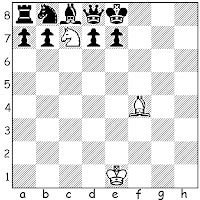
This is only a DEMONSTRATION -
not a real game position!
This knight fork is sort of the same as the f7 fork, but the other way around - the white knight now CHECKS the king and forks the a8 rook. The queen CAN, of course take the knight... ;) I do not remember a position in one of my games where a king-rook check fork occurred, so if you remember a position, I'd be really grateful if you could leave a comment. See the bottom of this blog post for more details. Thanks!


The dangers to queen-side castling
In the diagram on the left, black is about to castle. If he chooses to castle king-side, then FINE - go on! However, what about QUEEN-SIDE castling? It can't hurt, can it?!

Oh yes it can... (Click on the image below to view the animation)
A neat knight fork by white - I like it!
Of course, in a REAL game, black's pawns would NOT all be on their starting positions - this is just a demonstration. Remember to always watch out for pesky knight forks after you castle queen-side - it's happened to me!!


So the next time you play a chess game, always watch out and CHECK IF YOUR ROOKS ARE UNDER THREAT!! ;) Part 2 of Poor, Vulnerable Rooks!! will focus on other pieces' ways of annihilating rooks.

Do YOU have any experience of other ways that rooks can be mercilessly tortured? Torture by any piece will do - please leave a comment and share the chess world your knowledge! ;) Help me add some more info onto the next part of this blog post. Thanks!

  • I would be really grateful if you could, in your comment, describe exactly the position of the chess board.
  • Starting from left to right, write the contents of each square.
  • Black is abbreviated "B", white is "W"
  • E.g. for a white bishop, write "WBishop"
  • If a square is blank, write "nil"
  • Separate squares by commas. E.g. "WRook, WKnight"
  • If a new rank starts, write "-". E.g. "nil - WPawn"
  • If a lot of the same type of piece are consecutively placed, write the number of consecutively placed pieces there are, following by what type of piece they are. E.g. "8BPawns", "5nils"


For example, the f7 queen-rook fork position on the left could be described like this: "BRook, nil, BBishop, BQueen, BKing, BBishop, nil, BRook - 4BPawns, nil, WKnight, BPawn, nil - 2nils, BKnight, 2nils, BKnight, nil, BPawn - 4nils, BPawn, 3nils - 2nils, WBishop, nil, WPawn, 3nils - 8nils - 4WPawns, nil, 3WPawns - WRook, WKnight, BBishop, WQueen, WKing, 2nils, WRook."

Thank you for taking your time to share the chess world your knowledge! Thank you! :)

Friday, 8 April 2011

The Ruy Lopez Exchange Variation

(The big pictures in this blog post are ANIMATED pictures. Click on them to view the animation. The small pictures are NON-ANIMATED)


The Ruy Lopez is named after a Spanish priest called Ruy Lopez. It is one of the most studied and popular openings ever, and is commonly played at Grandmaster Level. The Ruy Lopez begins with these moves:
(1. e4 e5 2. Nf3 Nc6 3. Bb5)

Ruy Lopez Opening
What white is trying to do here is WIN A PAWN - his white bishop on b5 attacks black's knight that defends the pawn on e5.


Today we are going to look at one variation of the Ruy Lopez:


Ruy Lopez Exchange Variation:


(3...a6 4. Bxc6 dxc6)
It now SEEMS that white can take the pawn on e5 for FREE... but NO!


So black gets the pawn back by a QUEEN FORK. After black and white exchange queens, BLACK HAS A BETTER POSITION BECAUSE WHITE CANNOT CASTLE ANYMORE.  So DON'T take the pawn on e5 - YET anyway...


What white should do after his knight and black's bishop exchange, is to CASTLE. Then, if black is not careful, something terrible will happen to him!


Here is the position after white CASTLES. (5. O-O) What black should do now is DEFEND the pawn on e5 with something like 5...f6, 5...Qd6 or 5...Bd6. BUT... what happens if black does the obvious developing move 5...Nf6???


THIS is what happens... 
AND BAM! Black's queen is PINNED and it is officially dead! If you are black you must be extremely careful.


Now, let's see what happens if black DOESN'T try to fork white's knight and pawn again, but takes white's pawn on e4 instantly. 
This time, if black's knight on e4 moves, white will play 8. Nxc6+ - It's CHECK from the rook on e1 and the knight attacks black's queen.


Again, black's queen is dead. If however, black DEFENDS his knight on e4, white just plays 8. d3 and again, if black moves his knight, 9. Nxc6+ will win black's queen, so black will have to sacrifice his knight.

TOMORROW, we are going to look at a trap black can set in the Ruy Lopez Exchange Variation, and how he can checkmate white early in the game if white falls for it!